



You Can’t Automate Chaos (Structure First, Technology Second)
Strong Opinion: Buying a new app won’t fix your business. It will just make your existing chaos run faster.
Most SMEs don’t have a “tool problem.”
They have a structure problem — and they’re trying to solve it with software.
_0_a2ac95fb7fcd4e8ca0de320d86364ec9_1.png)
The Misconception: “This New Tool Will Fix Everything”
There’s a moment every founder hits.
Too many leads to follow up. Too many invoices to send. Too many messages to reply to. Too many half-finished tasks floating around.
And the brain goes: “We need software.”
Not because software is bad — it isn’t. But because buying a tool feels like progress.
It feels easier than doing the boring work: defining the workflow, setting responsibilities, writing checklists, and cleaning up the mess.
So SMEs buy:
- new CRMs
- new project boards
- new automation tools
- new “AI assistants”
- new dashboards
And they expect relief.
But instead, they often get: a more expensive version of the same chaos.

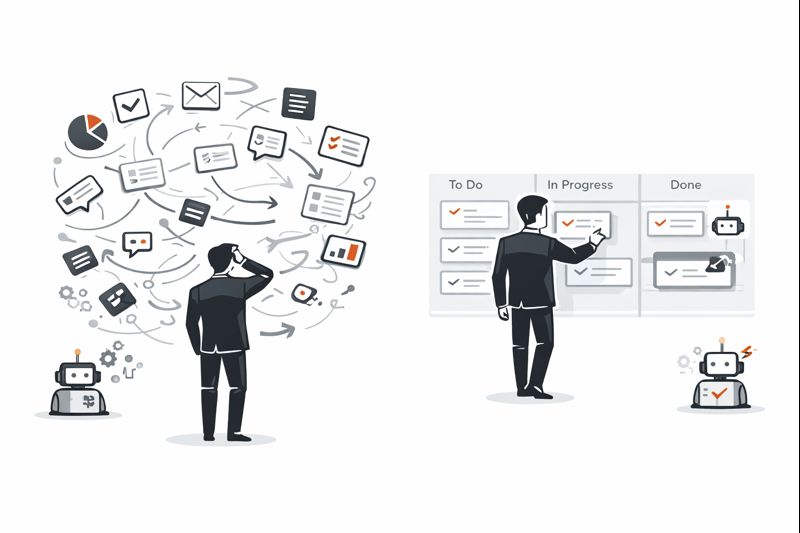
The Reality: Automation Amplifies What You Already Have
Automation is powerful. AI is powerful.
But they don’t create order.
They amplify whatever is already in your business:
- If you have clarity → automation creates leverage
- If you have chaos → automation creates faster chaos
Automating a messy workflow doesn’t make it clean.
It makes it louder.
You end up with:
- follow-ups sent at the wrong time
- clients receiving inconsistent messaging
- tasks duplicated across tools
- automations that nobody understands
- work moving faster… in the wrong direction
The worst part is you don’t just lose time.
You lose trust — internally and with customers.
The Truth: Structure First. Technology Second.
The real solution is simple:
Get your house in order, then bring in the robots.
Before you automate anything, you need to know:
- What the process actually is (step-by-step)
- Who owns each step (no ambiguity)
- What “done” means (standard outcome)
- What triggers the next step (clean handovers)
This is the philosophy behind WAi Forward.
We treat work as structured objects and workflows first — then automation becomes simple.
That’s why RunWAi is object-oriented. It treats Leads, Tasks, Posts, and Invoices as structured work items with lifecycles — not random admin floating around in inboxes.
Once the work is structured, automation stops feeling overwhelming. Because you’re not automating “everything.”
You’re automating one defined step in a clear process.
The Fix: Standardise Manually, Automate Gradually
You don’t need a massive transformation project.
You need a repeatable workflow that makes sense.
Start with the boring basics:
- a checklist
- a template
- a simple SOP
- a single “source of truth” tool
Then automate the repetitive part.
That’s how you get real ROI from automation. Not because the tool is clever — but because the workflow is clean.
What to Do Next: One Process, One Fix, One Automation
Here’s how to do it without overwhelming yourself.
-
Identify one recurring process.
Pick something that happens every week: lead follow-up, invoicing, onboarding, reporting, content scheduling. -
Write the steps from start to finish.
Don’t make it perfect. Make it real.
If your process lives in your head, it isn’t a process — it’s a risk. -
Clean it up manually first.
Remove pointless steps, clarify ownership, simplify the handover points. Turn vague “we’ll deal with it” into clear actions. -
Automate one step.
Not the whole business. One step that repeats and drains time: follow-up emails, invoice generation, reminders, simple admin.
That’s how you automate properly: with clarity, control, and real efficiency gains.
If you want automation that actually makes your business easier to run, you don’t start with tools.
You start with structure.
Then you use technology to scale what already works.