



The Near-Cashflow Collapse (or How I Nearly Went Broke Keeping Quiet)
On paper, everything looked fine.
Clients were happy. Projects were moving. The team was busy in a good way — the kind of busy that makes you think, “Right, we’ve cracked it.”
And that’s why what happened next caught me so off guard.
Because the business didn’t nearly collapse because we ran out of work.
It nearly collapsed because we ran out of cash — quietly, slowly, and then all at once.
I’d made a mistake that’s painfully common for founders who are focused on delivery:
I wasn’t watching cash flow closely enough.
Not properly. Not as a weekly habit. Not as something I treated with the same seriousness as sales and delivery.
We had invoices out. We had money owed. We had “good clients”.
So I assumed we were safe.
The Scenario: “They’re Good For It”
It started small.
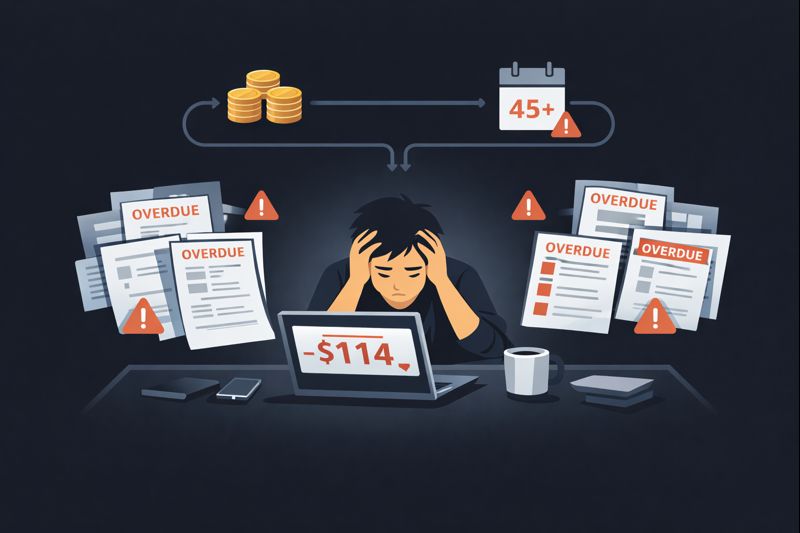
One larger client drifted past their payment terms. At first it was a few days. Then it became a couple of weeks. Then it quietly became 45 days overdue.
At the same time, there were a couple of smaller clients who were always late — not dramatically late, just consistently late enough that you could never rely on their payment landing when you expected it.
I noticed it, but I didn’t treat it as urgent.
I told myself the same comforting founder phrases people always tell themselves:
“They always pay eventually.”
“It’s not worth making things awkward.”
“We’re delivering well — the money will follow.”
And while I was thinking that, we kept delivering.
More work. More time. More output.
Which, in hindsight, was the worst possible thing to do — because it meant our exposure was increasing every week.
We weren’t just waiting for money that was late.
We were actively adding to the amount that was late.
What Went Wrong: Payday Arrived
Then payday arrived.
I remember opening the bank account and feeling that instant confusion you get when your brain refuses to accept what it’s seeing.
The balance looked… wrong.
Not “tight”. Not “a bit lower than expected”.
Wrong.
We were tens of thousands short. The money existed on invoices, but it wasn’t in the bank.
And that distinction — the difference between owed and available — suddenly became very real.
We couldn’t cover payroll cleanly.
We couldn’t cover rent comfortably.
We couldn’t absorb any surprise costs at all.
All because a chunk of our cash was locked up in accounts receivable, and I’d been treating it like an admin issue instead of a survival issue.
_0_a87431c212e94a9681987f550dd2bc40_1.png)
The next week was a blur.
It was awkward phone calls with people I normally spoke to casually.
It was carefully worded emails that were trying to be polite while also screaming, “We need this paid.”
It was negotiating partial payments, chasing finance departments, and trying to pull forward cash in any way we could.
And it was me quietly dipping into personal funds to cover gaps I didn’t want the team to feel.
We got through it.
But only just.
And the stress of that week sat in my chest for months afterwards, because it made one thing painfully clear:
It didn’t matter how well we were performing if we couldn’t pay our bills on time.
Moment of Realisation: Cash Flow Failure Is a Classic SME Killer
After things stabilised, I did what most founders do after a scare: I tried to make sense of it.
I started reading about why small businesses actually fail — not the dramatic stories, but the boring, common reasons.
And one statistic kept coming up in different forms:
A large majority of small business failures are cash-flow related (often quoted around 82%).
That number hit me harder than it should have, because I suddenly understood how it happens.
It isn’t always reckless spending.
It isn’t always bad sales.
Sometimes it’s just:
Good work delivered… and payments arriving late.
The founder assumption I’d been operating under was:
“As long as we’re making sales, we’re fine.”
But sales aren’t safety.
And profit on paper means nothing if the money isn’t in the bank when payroll is due.
The Lesson: Cash Flow Is the Lifeblood
This is the principle I took from it — the one I wish I’d learned earlier:
Cash flow is the lifeblood of the business. Treat it like oxygen.
You can survive a slow month of sales.
You cannot survive being unable to pay your team.
And you cannot “mindset” your way out of a cash gap created by late payers.
You have to manage it.
Which means monitoring it properly and being willing to have money conversations early — before they become emergency conversations.
The Takeaway: You’re Not a Bank
If you’re a founder who avoids chasing invoices because it feels uncomfortable, I get it.
Most founders don’t want to feel like they’re being pushy. You want to be liked. You want to keep relationships smooth. You want to focus on the work.
But here’s the reframe that helped me:
Enforcing payment terms isn’t being difficult. It’s being responsible.
Your business can’t function if you become an interest-free lender.
And the clients worth keeping will respect clear, consistent boundaries.
What To Do Next: A Simple Cash Flow Routine
You don’t need complex finance software to avoid this trap.
You just need a basic routine you actually follow.
1) Track cash weekly (not monthly)
Once a month is too slow. By the time you notice a problem, it’s already happening.
Set a weekly habit where you look at:
- cash in the bank right now
- invoices due in the next 7–14 days
- your fixed costs (payroll, rent, subscriptions)
- anything unusually large coming up
This isn’t about forecasting perfectly.
It’s about seeing the direction early enough to act.
2) Stop being surprised by late payers
If a client is “always late”, treat that as a fact, not a hope.
Adjust terms. Shorten payment windows. Request deposits. Move to staged payments.
Late payers don’t just create admin work. They create risk.
3) Put consequences in writing
This is the uncomfortable one, but it matters.
If you have no stated consequence for late payment, you’ve accidentally trained clients that late payment is acceptable.
Common options:
- late fees (even small ones change behaviour)
- pause work if invoices pass a certain threshold
- require payment before the next milestone
The key is communicating it upfront, calmly, and consistently.
4) Build a buffer (even a small one)
A buffer turns cash flow from a constant threat into something you can manage.
If “3 months of operating costs” feels impossible, aim for one month first.
The point is not perfection — it’s breathing room.
A Final Thought: Quiet Problems Don’t Stay Quiet
This is what makes cash flow so dangerous.
It can look fine… right until it doesn’t.
And founders often only notice when the consequences are immediate: payroll, rent, tax, suppliers.
If you take one action this week, make it this:
Look at your cash position, your receivables, and your next 30 days of obligations — and treat what you see as real.
Because the business doesn’t survive on sales.
It survives on cash.
If you want to systemise this, that’s exactly the problem PAI it Forward is built for — helping SMEs track money movement, stay on top of receivables, and reduce the “quiet drift” that turns into panic. But even without tools, the routine above will keep you safer than most founders realise.