



The 3 Pillars Every Modern SME Must Build: Influence, Time, Money
In today's rapidly evolving business landscape, small and medium-sized enterprises face relentless pressure to adapt and grow. For many SMEs, the default mode is still one of organised chaos: juggling tools, reacting to problems, and relying on heroic effort to keep everything moving. That approach might work in the short term, but it isn't sustainable. To build a business that can grow calmly and consistently, you need a stronger foundation.
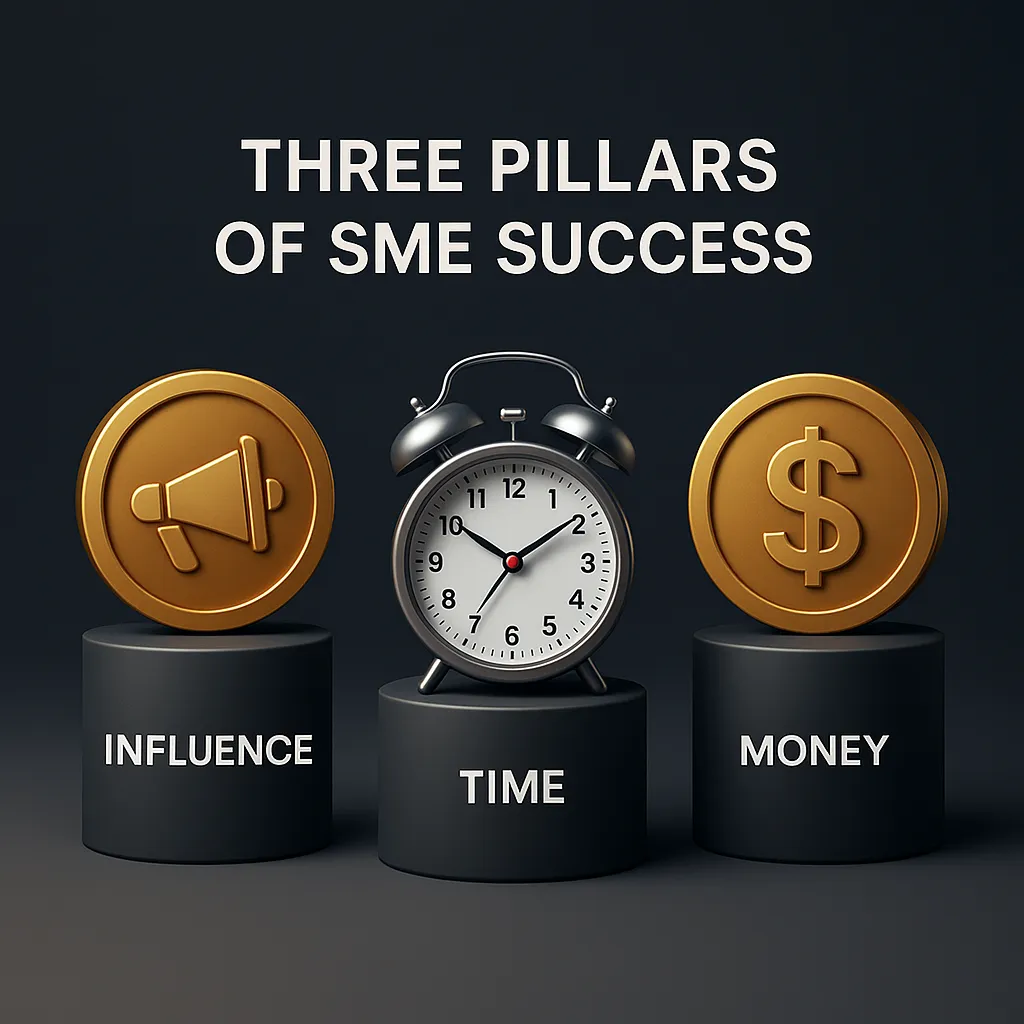
At WAi Forward, we think of that foundation as three core pillars: Influence, Time, and Money. These aren't abstract ideas; they map directly to the work you do every day. Influence is how you attract and nurture customers. Time is how effectively you turn effort into progress. Money is how well you manage the resources that keep your business alive. When you neglect any one pillar, the whole structure becomes unstable. When all three are strong and connected, your business becomes resilient, scalable, and far less chaotic. The accompanying slide deck captures this visually with three columns representing Influence, Time, and Money holding up the future of the SME. :contentReference[oaicite:2]{index=2}
Why These Pillars Matter More Than Ever
These three pillars aren't new. Businesses have always needed customers, operational efficiency, and sound finances. What has changed is the level of complexity and pace of work SMEs face today. Markets move faster, expectations are higher, and there's less tolerance for inconsistency or poor communication. The slides in your PDF break this down clearly: Influence is no longer just about having a good product, Time must be protected from wasteful repetition, and Money requires informed decisions rather than guesswork. :contentReference[oaicite:3]{index=3}
Meanwhile, generic AI tools have exploded in popularity. They can draft emails, suggest campaign ideas, or summarise information. But on their own, they rarely solve the core operational challenges SMEs face. They generate content; they don't build systems. To strengthen Influence, Time, and Money in a meaningful way, SMEs need structured automation and repeatable workflows, not just clever prompts.
1. Influence: Building Trust, Visibility, and Demand
Influence is more than publicity or awareness. It's your ability to consistently reach the right people, earn their trust, and move them from curiosity to commitment. On page 2 of the slide deck, Influence is described as "more than just a good product" – in a crowded market, consistent engagement is what turns strangers into loyal customers. :contentReference[oaicite:4]{index=4}
Many SMEs already understand this in theory, but struggle in practice. Marketing gets done in bursts when someone has time. Lead follow-up depends on memory. Content is posted when inspiration strikes. The result is an inconsistent presence that makes it harder to build authority or maintain momentum.
Lead the WAi exists to change that. Powered by RunWAi, our object-oriented AI engine, Lead the WAi treats key elements of your marketing and sales process as structured objects: Leads, Campaigns, Email Sequences, Posts. Each object has a defined lifecycle, from first touch to closed deal. That structure allows you to:
- Capture leads through consistent, trackable entry points.
- Automatically nurture those leads with relevant, scheduled content.
- Trigger follow-up actions based on behaviour and lifecycle stage.
- Ensure no opportunity quietly slips through the cracks.
AI assists with drafting content, suggesting subject lines, and proposing next steps, but you remain in control of tone and strategy. This is Influence built on systems rather than chance.
2. Time: Protecting Your Most Valuable Asset
Time is the pillar most SMEs feel slipping away. Page 3 of the PDF summarises this neatly: "Time: Your Most Valuable Asset – streamline operations to reduce mental load and focus on growing your business." :contentReference[oaicite:5]{index=5}
In many small businesses, talented people spend most of their day on low-value tasks: chasing updates, manually updating boards, re-entering data, or searching for missing information. None of this is why they were hired. And yet, without structure, the admin fills every available gap.
PathWAI is designed to reclaim this pillar. Instead of tasks living in people's heads or scattered apps, PathWAI treats Tasks, Projects, and Workflows as objects within RunWAi. Each has a lifecycle: drafted, assigned, in progress, completed. That structure allows you to:
- Design clear workflows for common processes (onboarding, campaigns, reporting, content production).
- Automate task creation and assignment based on triggers from other parts of the business.
- Give every team member a clear view of what's next, instead of relying on constant check-ins.
- Reduce interruptions, context switching, and duplicated work.
AI can assist by prioritising tasks, suggesting deadlines, and even summarising meetings into actionable steps. But it doesn't replace judgment; it gives your judgment more space to operate by reducing noise.
3. Money: From Guesswork to Informed Decisions
Money is the pillar that keeps everything else standing. Page 4 of the slide deck emphasises the importance of tracking finances, understanding cash flow, and planning for the future without guesswork. :contentReference[oaicite:6]{index=6}
Many SMEs still rely on manual spreadsheets, late-night reconciliations, and a rough sense of "how things are going." That might work when you're very small, but it becomes increasingly risky as you grow. Cash flow surprises, missed invoices, and unclear margins all limit your ability to invest confidently.
PAI it Forward addresses this by treating Invoices, Expenses, Payments, and Reports as structured objects inside RunWAi. Every financial event becomes part of a clear, connected lifecycle. This allows you to:
- Generate invoices automatically when work is completed or milestones are hit.
- Track payments and follow up intelligently, without manual reminders.
- Categorise expenses consistently for clearer reporting and forecasting.
- Build a live picture of your cash flow rather than relying on month-end surprises.
AI helps by drafting invoice line items, flagging anomalies, and highlighting trends. You still make the decisions — but you do so with structured, up-to-date data instead of incomplete snapshots.
The Power of Object-Oriented AI Across All Three Pillars
What makes this approach different from traditional tools is the underlying model. As highlighted on page 5 of the slide deck, generic AI isn't enough. Treating work as structured objects enables predictable outcomes and truly efficient workflows. :contentReference[oaicite:7]{index=7}
RunWAi, the engine behind all WAi Forward platforms, doesn't just generate text. It understands that a Lead is different from a Task, and a Task is different from an Invoice. Each has its own lifecycle and its own role in your business. When automation operates at this level, it can:
- Move data cleanly between marketing, operations, and finance.
- Trigger actions in one pillar based on events in another.
- Maintain context so that every automated step makes sense.
This is the difference between a collection of tools and a unified system. It's how you turn Influence, Time, and Money from three separate concerns into one connected foundation.
Hybrid AI–Human Workflows: Automation Without Losing Authenticity
Page 6 of the slide deck captures WAi Forward's philosophy in a single line: "Hybrid AI–Human Workflows: The Key." AI assists, suggests, and drafts; humans review, approve, and guide. :contentReference[oaicite:8]{index=8}
We don't believe in replacing people. We believe in removing the repetitive, low-value work that stops them doing their best work. That means:
- AI can prepare the first draft of a campaign; you decide the final message.
- AI can propose task assignments; you confirm priorities.
- AI can highlight financial trends; you choose how to respond.
This hybrid model gives you the best of both worlds: the speed and consistency of automation, with the nuance and judgment of human decision-making. It keeps your brand voice, your ethics, and your relationships at the centre of your business, even as you scale.
The Power of a Unified Ecosystem
One of the biggest advantages of WAi Forward is that Lead the WAi, PathWAI, and PAI it Forward all run on the same RunWAi engine. They are not isolated products; they are parts of a single ecosystem. A new lead captured by Lead the WAi can automatically create tasks in PathWAI. Once work is complete, PAI it Forward can generate and track the related invoice. No manual copying. No disconnected systems. Just one coherent flow.
This is how the three pillars reinforce each other. Influence generates demand. Time ensures the work is delivered efficiently. Money captures the value created. And the underlying object-oriented system ensures nothing gets lost between those stages.
Ready to Build a Stronger Foundation?
The final slide in your deck asks a simple question: "Ready to build a stronger foundation?" :contentReference[oaicite:9]{index=9} For SMEs, the answer increasingly needs to be yes. The future of work is not just about surviving another wave of change; it's about creating a business that can grow calmly, sustainably, and profitably.
By building on the pillars of Influence, Time, and Money — and by using structured AI to connect them — you can create a business that is less reactive and more intentional. A business where your systems support you, instead of you constantly holding everything together.
Ready to strengthen your three pillars and build a more resilient SME? Learn more about WAi Forward and request a demo today.
Frequently Asked Questions
What do you mean by "object-oriented AI"?
Object-oriented AI means treating key elements of your business — such as Leads, Tasks, Posts, and Invoices — as structured objects with defined lifecycles. Instead of reacting to isolated prompts, the system understands where each object is in its journey and what should happen next. This makes automation more predictable, more controllable, and more useful for real SMEs.
Do I need all three platforms to benefit from WAi Forward?
No. Many businesses start with the pillar that hurts most — often Influence (Lead the WAi) or Time (PathWAI) — and expand as they see the benefits. Because everything runs on RunWAi, you can add other platforms later and they will connect naturally to the systems you've already built.
Will automation replace my team?
WAi Forward is designed for hybrid AI–human workflows. Automation handles repetitive, low-value tasks so your team can focus on strategy, creativity, and relationships. You stay in control of approvals, decisions, and brand voice while AI handles the heavy lifting in the background.
Is this only for tech-savvy businesses?
No. WAi Forward is built specifically for SMEs, including founders and teams who don't see themselves as "technical." Our goal is to make structured automation accessible and practical, not overwhelming. You don't need to be an engineer to benefit from systems that keep your work organised and moving.
How does this help with burnout?
Burnout often comes from trying to keep too many things in your head while fighting constant fires. By systemising your Influence, Time, and Money pillars, you remove much of that mental load. Workflows become predictable, follow-ups are handled, and finances are clearer — giving you more space to think and breathe.