



Shiny Object Syndrome: The Side Venture That Siphoned My Focus
There’s a moment that hits a lot of founders after a bit of traction.
The main business is working. Clients are coming in. Delivery is busy but manageable. You start to feel like you’ve earned the right to breathe for a second.
And then a new idea appears.
Not a small tweak. Not a sensible extension.
A whole new venture.
Something in a different space, with a different audience, and a different set of problems to solve.
It looks exciting. Clean. Full of potential. It feels like the version of business you’re “supposed” to be building next.
And because founders are wired to chase possibility, it’s very easy to tell yourself:
“I can run both.”
I did.
I was still running my core SME — serving clients, delivering work, managing the team — and I jumped headfirst into a second business idea that had nothing to do with the first.
At the time, I thought I was diversifying.
In reality, I was splitting focus before I’d earned the right to split focus.

The Scenario: Two Businesses, One Brain
The pattern was predictable.
During the day, I’d be in the “real” business: client delivery, calls, problem solving, team questions, deadlines.
Then at night, I’d switch to the new idea: planning, research, experimenting, building, learning a new market.
At first, it felt energising.
The new venture gave me a hit of momentum — the feeling of starting fresh, with none of the operational mess of the existing business.
But that feeling is exactly why shiny object syndrome is so dangerous:
new things feel clean because they haven’t been stress-tested yet.
Old businesses have reality. New businesses have fantasy.
And I started favouring the fantasy.
What Went Wrong: Both Started to Wobble
The first business didn’t collapse.
It just got… slightly worse.
And “slightly worse” is how most founders lose control without noticing.
Clients picked up on my distraction.
Not because I said anything, but because the little things started slipping:
- responses got slower
- follow-ups got missed
- small delivery issues took longer to catch
- the team didn’t have fast decisions when they needed them
Nothing dramatic.
Just enough that the business felt less sharp.
At the same time, the new venture struggled for the opposite reason.
I’d underestimated how much time and learning curve it would take.
Starting something new isn’t just “doing more work”. It’s doing work you’re not yet good at:
- new customers
- new positioning
- new operations
- new mistakes
- new unknowns
And because I was already stretched, I couldn’t give it the consistent attention it needed to stabilise.
So after a few months, I ended up in the worst middle ground:
two ventures, neither getting enough focus to be excellent.
I was exhausted.
The team could feel it.
And instead of feeling proud that I was “building more”, I just felt behind everywhere.
The Realisation: You Can Do Anything, But Not Everything
The real shift came when I finally admitted something I didn’t want to admit:
I hadn’t finished building the first business.
I’d built something that worked when I was fully present.
But it wasn’t systemised.
It wasn’t stable enough to run smoothly without my attention.
And because of that, trying to add a second business wasn’t “expansion”.
It was introducing fragility.
A mentor said something that stuck with me:
“You can do anything, but not everything — at least not at the same time.”
It wasn’t advice to stop thinking big.
It was advice to respect sequencing.
The Lesson: Earn the Right to Diversify
The grass always looks greener when you’re tired of the business you already have.
But the answer usually isn’t a new venture.
The answer is making the current business calmer, cleaner, and more predictable.
Because once your core business is:
- systemised
- documented
- stable on cash flow
- less dependent on you day-to-day
…then a new idea becomes a genuine choice.
Not an escape hatch.
And it becomes far more likely to succeed, because you’re building it from a place of stability rather than stress.
Takeaway: Guard Your Focus Fiercely
New ideas will always show up.
That’s not the problem.
The problem is acting on them too early, before the current business is stable enough to handle your attention shifting away.
Focus isn’t about saying “no” forever.
It’s about saying “not yet” until the timing is right.
Action Step: Do a Brutal Readiness Check
If you’re itching to start a new project, ask yourself these questions honestly:
- Is the current business in true maintenance mode? Or does it still rely on you to hold it together?
- Is cash flow steady enough that a distraction won’t create panic in 60 days?
- Are your core processes documented so delivery doesn’t degrade when you’re not watching?
- Is there someone who can run daily ops without constantly escalating decisions back to you?
If the answer is “no” to any of the above, that’s your real work.
Build the foundation first.
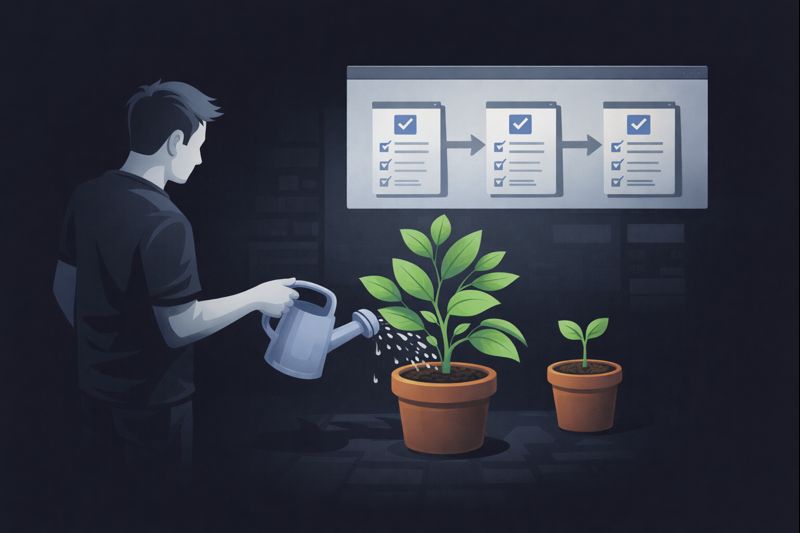
Water the grass you already have.
Then, when you’re truly ready, the next venture won’t siphon your focus — it’ll benefit from everything you’ve already built.