



It’s Not Your Team — It’s Your Process
Contrarian Claim: If your employees keep “messing up,” the fault is usually your systems — not your people.
Most founders don’t want to believe this. Because it’s easier to blame performance than to redesign the machine that creates the performance.
But in SMEs, the team is rarely the root issue. The system is.
The Common Reaction: Blame the Team
When something goes wrong in the business, most founders default to one of these thoughts:
- “I must have hired wrong.”
- “They don’t care as much as I do.”
- “Why do I have to check everything?”
- “I can’t rely on anyone.”
And sometimes… sure. People can be underperforming. People can be careless. People can lack experience.
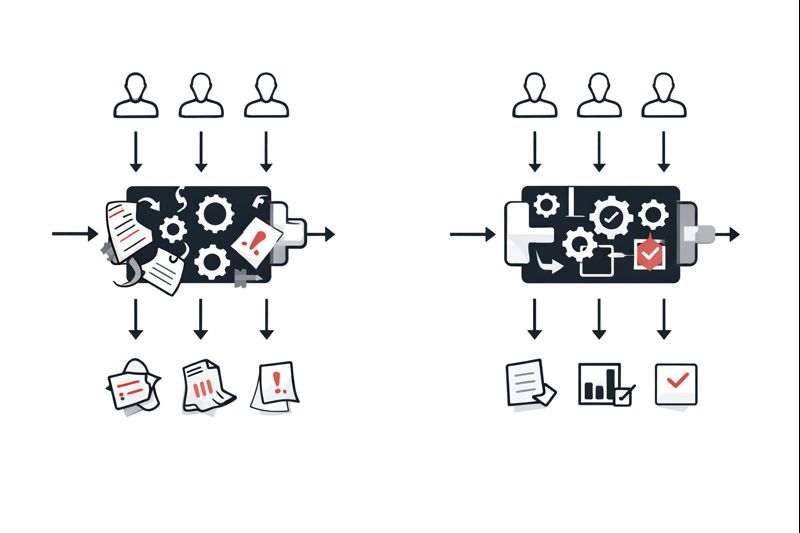
But in most SMEs, repeated mistakes aren’t caused by bad intent. They’re caused by unclear work.
A team can’t deliver consistent results when they’re operating inside a system that’s inconsistent.
If everything is verbal, last-minute, and constantly changing… mistakes aren’t surprising. They’re guaranteed.
The Truth: Clear Process Creates Consistent Output
Here’s the truth founders don’t like hearing:
People don’t “mess up” in a vacuum.
They mess up inside the environment you built.
Most errors are symptoms of one of these:
- Unclear instructions: “Just do it like last time” isn’t a process.
- Undefined ownership: Everyone assumes someone else is doing it.
- No checklist: Steps get skipped under pressure.
- No template: Work gets reinvented every time, with different standards.
- No training system: People learn by guessing and hoping.
- Too much context switching: Tiny mistakes happen when people are pulled in five directions.
There’s an old saying: “There are no bad soldiers under a good general.”
In business terms:
Good people + weak systems = weak results.
You can hire the best person in the world… and still get inconsistent output if the workflow is unclear.
Why This Matters: You’re Not Just Managing People — You’re Managing Reality
A founder’s job isn’t to personally catch every error.
Your job is to build a business where:
- tasks are repeatable
- handoffs are clean
- quality is predictable
- mistakes get less frequent over time
If the system relies on your memory to work, it isn’t scalable. And it isn’t fair on your team.
The best teams don’t succeed because they try harder. They succeed because the work is designed well.
And the real benefit is this:
Fix the workflow, and the “people problem” often disappears.
The Fix: Diagnose the System, Not the Person
When something goes wrong, most SMEs do this: “Who did it?”
But better businesses ask: “What allowed this to happen?”
That one shift changes everything. Because it turns mistakes into improvements — not blame.
Instead of replacing a team member after a misstep, map out why it happened. Was it:
- a missing checklist?
- unclear responsibility?
- an unrealistic workload?
- a rushed handover?
- information buried in messages?
- a decision that wasn’t documented anywhere?
Most “team mistakes” are actually process gaps. And process gaps are fixable.
What to Do Next: Fix One System Gap This Week
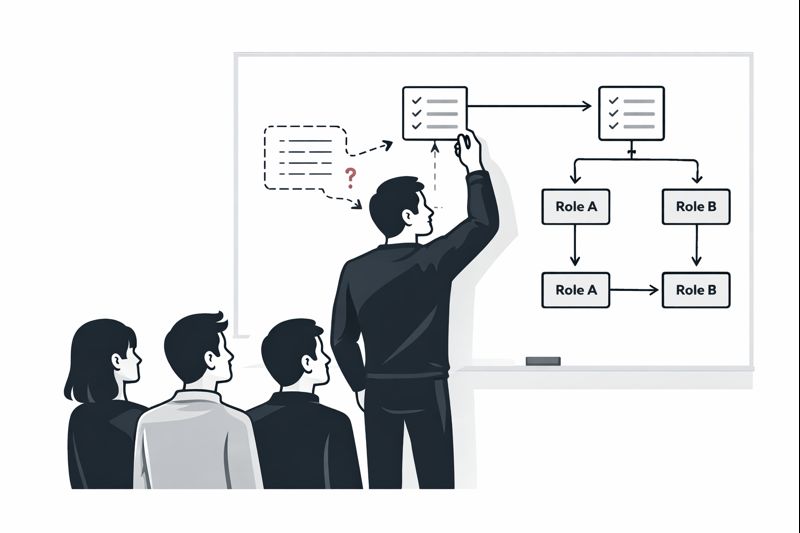
You don’t need a “new team culture” to fix performance. You need one clearer process.
-
Do a quick root cause analysis on the last issue.
Pick the last mistake, client complaint, missed deadline, or internal fire. Ask: what was missing that would have prevented it?
Write down the gap without naming people. -
Implement one simple fix.
Add a checklist. Create a template. Write a 5-step SOP. Record a 3-minute training video. Keep it small and usable. -
Say this in your next team meeting.
“We’re not here to blame people — we’re here to improve the system.” You’ll reduce fear, improve honesty, and build trust quickly.
That’s how high-performing teams are built. Not through pressure. Through clarity.
At WAi Forward, we build tools around this exact principle: your business runs best when work is structured, visible, and repeatable.
RunWAi treats work as objects with lifecycles — not vague tasks floating around in inboxes. When processes are structured, teams don’t guess. They execute.
Stop blaming the team. Fix the system. And watch performance improve without replacing the people you already paid to hire.