



ChatGPT has become one of the most powerful and flexible AI tools available today. Beyond simple question-and-answer interactions, it can learn your preferences and adapt to your goals — but only if you teach it how. That’s where custom instructions come in. By setting them up carefully, you can make ChatGPT behave like a personalized assistant that understands your tone, context, and objectives from the very first message.
What Are Custom Instructions?
Custom instructions are a way to personalize how ChatGPT communicates and thinks about your questions. Instead of treating every user the same, it allows you to guide how the model responds — what tone to use, what kind of details to prioritize, and what background information to remember. It’s a simple but powerful way to make the AI feel genuinely attuned to you rather than a generic chatbot.
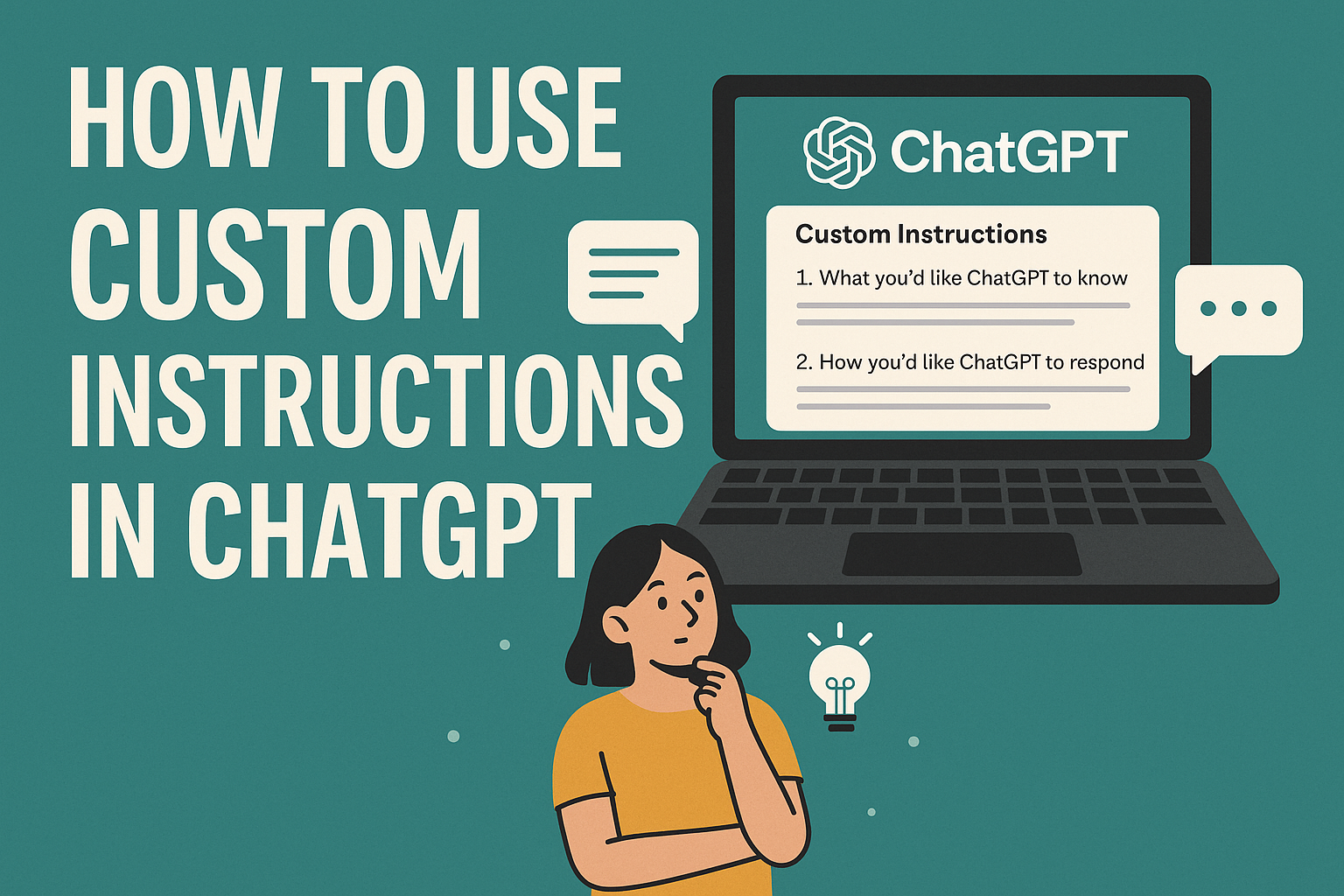
When you open the Custom Instructions form, you’ll see two short questions that define the model’s behavior:
- What you’d like ChatGPT to know about you – This helps it understand your background, interests, or profession so that answers are more relevant.
- How you’d like ChatGPT to respond – Here, you define the tone, level of formality, and style of explanation you prefer.
Once these are set, every new chat automatically adopts that personality and structure, saving you the time and repetition of restating what you need each time.
Why They Matter
Most people underestimate how transformative this feature can be. A good set of custom instructions turns ChatGPT from a reactive tool into a proactive collaborator. If you’re a developer, you can tell it to use concise, well-documented code snippets. If you’re a business owner, you can ask for responses written in a professional but friendly tone, with a focus on clarity and brevity. If you’re a student, you can ask it to explain answers like a tutor rather than a textbook.
These small preferences add up. The more detail you include about your goals and communication style, the better ChatGPT adapts to you. It’s like training an assistant to anticipate your needs rather than simply react to your questions.
Setting Up Your Custom Instructions
To access your custom instructions, open your ChatGPT settings and look for the “Personalize” or “Custom Instructions” section. You’ll find two text boxes — one for what the AI should know about you and one for how it should reply. Here’s a useful framework to get started:
Example 1: If you’re a content writer, you might write:
“I’m a digital marketing writer who focuses on SEO and audience engagement. Please use clear, natural language, avoid jargon, and include examples when explaining concepts.”
Example 2: If you’re learning to code:
“I’m a beginner Python developer. Please give simple, practical examples with step-by-step explanations. Avoid advanced terminology unless necessary.”
Don’t worry about getting it perfect the first time. You can edit these instructions anytime — and in fact, you should. As your work or learning goals evolve, updating them keeps ChatGPT aligned with your current needs.
Tips for Writing Effective Instructions
Think of your custom instructions as a short conversation with a new team member. You wouldn’t overwhelm them with every detail of your job — you’d give clear guidance on what matters most. Be specific, but keep it focused. If you ask for “creative and conversational writing,” don’t also request “strictly academic tone.” Conflicting instructions will confuse the model and lead to inconsistent results.
Also, don’t hesitate to create multiple versions for different workflows. You might have one profile for coding help, another for marketing copy, and another for research summaries. ChatGPT performs best when the expectations are clearly defined and purpose-driven.
Common Mistakes to Avoid
Two pitfalls often reduce the effectiveness of custom instructions: vagueness and overload. Vague instructions like “be smart” or “write well” give the AI nothing to work with. On the other hand, dumping paragraphs of unrelated context can make it less focused. A few concise, intentional sentences almost always perform better than an essay.
FAQs
- Do custom instructions apply to all my chats? Yes, once set, they apply automatically to all new conversations unless you change or remove them.
- Can I use different settings for different topics? Not directly, but you can update or save versions of your instructions for different tasks.
- Do they improve response accuracy? They don’t change the AI’s factual accuracy but make it more consistent and contextually aware of your needs.
- How often should I update them? Revisit them every few weeks or after starting a new project — think of it as tuning your assistant for each phase of your work.
- Are they stored securely? Yes, they remain private and tied to your account settings, not shared with others.