



How Do You Prioritize When Everything Is Urgent?
Ever have one of those days where absolutely everything is on fire? 🔥
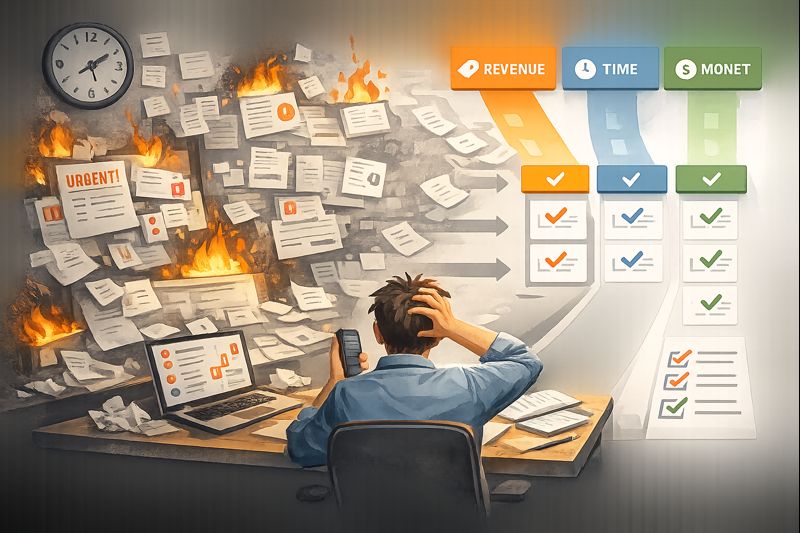
Not “busy”… not “a bit behind”… but genuinely everything feels urgent at the same time. A client message. A deadline. A payment. A team question. A lead going cold. A system breaking. And the worst part is you can’t tell what’s actually important — only what’s loud.
So I want to throw this one to the SME roundtable: how do you prioritize when it all feels urgent?
Do you have a real triage method? Do you grab help? Do you handle the squeakiest wheel first? Or do you just accept that some fires have to burn out on their own?

Honestly — I still struggle with this sometimes. When tasks and requests stack up fast, it stops feeling like “choosing priorities” and starts feeling like trying to stop the whole business from tipping over.
And that’s why this question matters. Because in real SMEs, “priority” isn’t always a calm decision. A lot of the time, it’s a survival skill.
Why Everything Feels Urgent (Even When It Isn’t)
One of the hardest things about running a small business is that urgency spreads. A small issue shows up, and suddenly it’s linked to three other things:
- If the client is unhappy, revenue is at risk.
- If revenue is at risk, cash flow gets tight.
- If cash flow gets tight, stress goes up.
- If stress goes up, mistakes happen.
- If mistakes happen… more urgency appears.
So even if a task isn’t truly critical, it can feel like it is — because your brain is doing the maths on what happens if it goes wrong.
And if you’re the founder, there’s usually another layer too: everything feels urgent because everything depends on you.
The “Triage” Question That Actually Helps
When things are chaotic, I think most founders try to prioritize by staring at a long list and hoping clarity appears. It rarely does.
A better way (in my experience) is to ask a smaller, sharper question:
“What breaks if this isn’t done today?”
Not “what do I want to finish.” Not “what would be nice to catch up on.” Not even “what’s most urgent.”
Just: what actually breaks?
Because when you’re overwhelmed, “urgent” becomes emotional. But “what breaks” is practical.
3 Real-World Buckets (That Most SMEs Live In)
If you want a simple way to sort chaos quickly, here’s a framework most SMEs already operate inside (even if they don’t name it):
- Revenue pressure: leads, sales, client delivery, retention, follow-ups
- Time pressure: workflow bottlenecks, staff questions, blockers, admin overload
- Money pressure: invoices, payroll, supplier payments, cash flow surprises
If something threatens one of those three, it usually belongs near the top of the list.
And the truth is… most “everything is urgent” days aren’t really about doing more. They’re about deciding which pressure you’re going to reduce first.
Hot Take: “Urgent” Is Often Just “Unowned”
Here’s my slightly spicy opinion for the roundtable:
A lot of urgency comes from tasks that don’t have clear ownership.
Not because people don’t care — but because in SMEs, responsibility is often “implied” rather than assigned. So small things sit around… until they become urgent.
And when nobody owns something clearly, the founder ends up owning it by default.
So sometimes the real fix isn’t “work faster.” It’s simply: make the task belong to someone (or something) properly.
Where Systems Help (Without Turning You Into a Robot)
This is the part that’s easy to miss: You don’t need a bigger to-do list. You need less manual thinking.
That’s one of the reasons we built RunWAi — because when your business is represented as structured objects (leads, tasks, posts, invoices, appointments), it becomes easier to see what’s stuck, what’s overdue, and what actually needs attention.
Not in a “10x productivity hustle” way. More in a “stop carrying everything in your head” way.
Over to You (SME Roundtable)
Alright — I want real answers on this, because every founder handles it differently.
Be honest: when everything feels urgent… what do you actually do?
- Do you have a strict method (time-blocking, Eisenhower Matrix, impact scoring, etc.)?
- Do you go with instinct?
- Do you clear the quickest wins first?
- Do you pick the most expensive problem first?
- Do you ask someone else to decide for you?
- Or do you just accept it’s going to be messy and keep moving?
And the bonus question: what’s the one “urgent thing” you wish you could delete from your business forever?
Drop your approach in the comments — even a one-liner helps. Someone reading this is probably having that day right now.
Hot take: Most “urgent” tasks aren’t urgent — they’re just the loudest. Agree or disagree?