



Every Process Needs an Owner
Principle: Assign clear ownership for every key process or project in your business.
Most SME chaos isn’t caused by bad people or poor effort. It’s caused by something far more common: nobody truly owns the process.
Work gets started… but not finished. Follow-ups happen… but inconsistently. Tasks move… but only when someone remembers to chase them.
And eventually you end up with the most dangerous phrase in business: “I thought someone else was doing it.”

Why It Matters
When accountability is unclear, things fall through the cracks. If “everyone” is responsible, no one truly is.
You see it most clearly in processes like:
• Sales follow-up (leads go cold because nobody chased them)
• Content and marketing (posting happens… when someone remembers)
• Customer support (replies are delayed because it’s unclear who owns it)
• Project delivery (handover steps get missed)
• Finance admin (invoices and cash flow updates drift)
High-functioning companies avoid this by ensuring each workflow has one accountable owner. That doesn’t mean one person does all the work.
It means one person is responsible for making sure the work moves forward and the outcome happens.
Owner Doesn’t Mean “Doer”
This distinction matters. If you make ownership mean “you do all the tasks”, nobody will want ownership.
Ownership means:
• keeping the workflow moving
• checking progress and removing blockers
• confirming the output meets the standard
• making sure deadlines don’t quietly slip
• reporting on the key numbers that matter
It’s responsibility for the outcome — even when tasks are delegated across the team.
Application: Put a Name Next to Every Key Process
This is a simple exercise that can instantly tighten your operations: list your major processes, then assign an owner to each one.
For a small team, you might wear multiple hats. That’s normal.
But even then, it’s still powerful — because now you know which hats are yours.
Example ownership assignments in an SME:
• Sales pipeline owner
• Content calendar owner
• Customer onboarding owner
• Delivery / quality control owner
• Finance admin owner
As you grow, you can delegate ownership formally — but the structure stays the same.
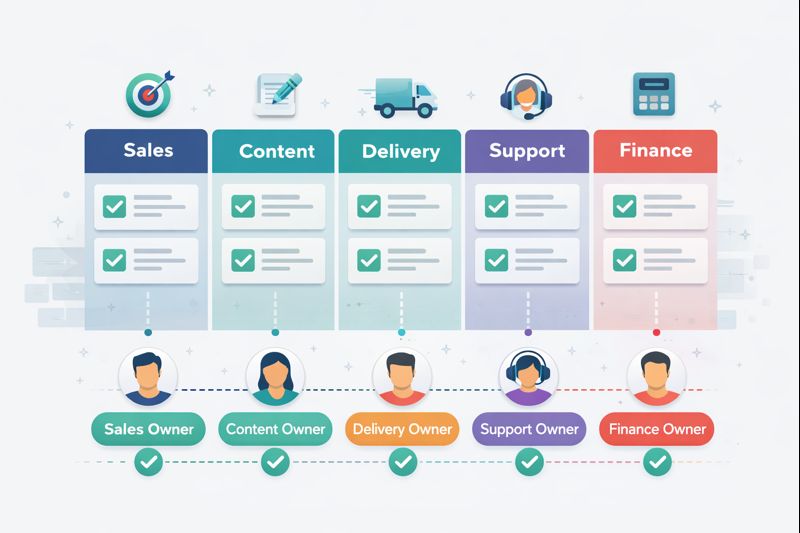
Metric: Use an Accountability Chart (Not Just an Org Chart)
Org charts show hierarchy. Accountability charts show reality.
Instead of listing people first, list processes first — and put responsible names next to each one.
The goal is simple: zero orphaned processes.
If something critical has no clear owner, assign one immediately. It’s one of the fastest ways to reduce chaos without hiring anyone new.
How WAi Forward Supports Process Ownership in Real SMEs
At WAi Forward, we build structured AI automation that helps SMEs create calm systems with clear ownership.
Our ecosystem is powered by RunWAi — our object-oriented AI engine — which treats work as structured objects (leads, tasks, posts, invoices) with defined lifecycles.
That structure makes ownership easier because the workflow is visible: who owns what, what stage it’s in, what’s blocked, and what needs action next.
It’s not “more admin”. It’s less chasing.
Roundtable Question
Be honest — what process in your business feels like it’s owned by “everyone”… which really means it’s owned by no one?
And if you assigned one clear owner to it tomorrow, what would improve first: speed, quality, or consistency?