



Don’t Hire for Chaos: Fix Your Process First
Strong Opinion: Hiring more people won’t fix a broken process. It will only amplify the chaos.
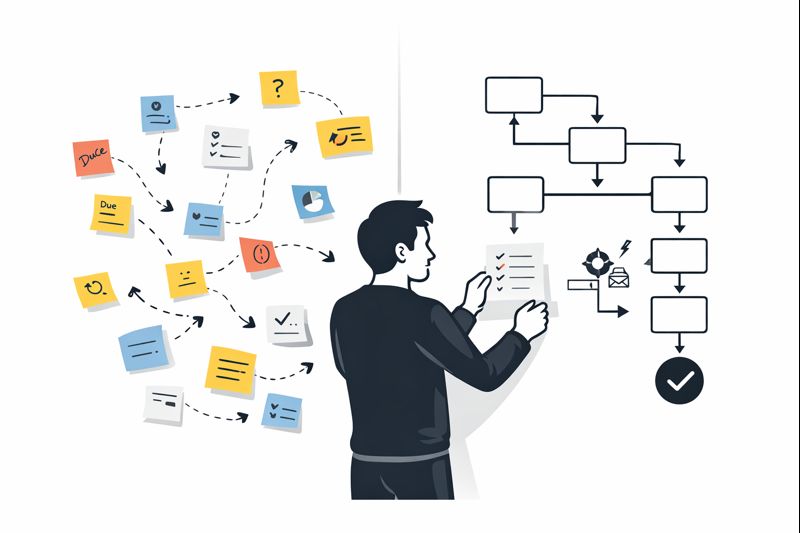
If your workflow is messy, adding headcount doesn’t create relief. It creates more coordination, more context-switching, more mistakes, and more management you didn’t have time for in the first place.

The Misconception: “I’m Overwhelmed, So I Need More People”
This is one of the most common SME founder reactions when things start to feel heavy.
You’re behind on messages. Clients want updates. Admin is stacking up. Leads are slipping. And the to-do list keeps growing no matter how early you start.
So you think:
“If I just hire someone, this all goes away.”
And sometimes, yes — headcount is the right answer.
But most of the time, in growing SMEs, overwhelm isn’t caused by a lack of people. It’s caused by a lack of process.
Hiring into that reality doesn’t reduce pressure. It spreads it across more people and turns your business into a bigger version of the same mess.
Why SMEs Fall Into It: Hiring Feels Like a Fast Fix
Hiring feels productive because it’s a visible action. It feels like progress. It feels like you’re “investing in growth.”
But the hidden truth is this:
Founders don’t hire because they have a growth plan.
They hire because they can’t breathe.
And when you hire from a place of pressure, you usually hire for relief, not for impact.
The problem is: if the work isn’t structured, you don’t actually know what you need help with.
So the new hire becomes a “general helper”: doing random tasks, plugging holes, chasing threads, and asking you constant questions — because there’s no defined workflow.
Which creates the worst-case scenario:
- You spend more money (salary + tools + onboarding time)
- You lose more time (training + clarifying + rescuing work)
- The business still feels chaotic (because the root issue wasn’t people)
Why “More Staff” Often Makes Chaos Worse
If your business is chaotic, it usually means one or more of these are true:
- Work lives in people’s heads instead of a system
- Nothing is documented
- The same questions are answered repeatedly
- Priorities change daily
- Tasks start but don’t finish cleanly
- Clients are updated inconsistently
- Delivery depends on memory and heroics
Adding a new person into that environment doesn’t create structure. It creates more pathways for confusion.
New hires don’t fix chaos. They suffer inside it.
And the real cost isn’t just financial — it’s operational. Because every messy workflow becomes a scaling problem.
You get:
- More mistakes: because processes aren’t repeatable
- More rework: because standards aren’t defined
- More questions: because answers aren’t captured anywhere
- More management load: because you become the human workflow engine
This is why “I hired and it didn’t help” is so common in SMEs.
It’s not because the hire was bad. It’s because the environment didn’t give them a fair chance.
The Truth: Process Before Headcount
The contrarian truth is simple:
You don’t scale by adding people.
You scale by improving the way work flows through the business.
In many cases, a clean workflow does one of two things:
- It reveals that you don’t need another hire — you need better structure.
- It reveals exactly what role you should hire for, because the gaps become obvious.
That’s why process always comes first. Because good processes create predictable work. Predictable work creates measurable workload. Measurable workload creates sensible hiring decisions.
Otherwise you’re guessing — and paying salaries to test your guesses.
The Real Fix: Build a Workflow That a New Hire Can Actually Step Into
Here’s the standard most SMEs forget:
A hire is only valuable when you can train them quickly and trust the output.
That requires:
- a clear process
- a defined “definition of done”
- templates, checklists, and consistent tools
- a predictable handover between stages
This is also where WAi Forward fits in. We help SMEs turn messy work into structured workflows — so growth becomes repeatable, not exhausting.
RunWAi is built around object-oriented workflows. Instead of everything being “random tasks,” your work becomes trackable objects with stages — like Leads, Posts, Tasks, and Invoices.
When your work is structured, you get clarity: what’s happening, what’s stuck, what needs attention, and what can be automated.
That’s the difference between “I need staff” and “I need a system.”
What to Do Next (Before You Spend a Penny on Hiring)
If you’re overwhelmed right now, don’t panic-hire. Do this instead.
-
Map one critical workflow.
Choose a process that happens often and causes stress — for example, onboarding a new client, quoting, invoicing, or handling a new lead.
Write out the steps from start to finish as they actually happen today (not how you wish they happened). -
Spot the “chaos points”.
Look for the moments where things break down: unclear ownership, missing info, duplicated work, repeated questions, “waiting on someone,” or anything that relies on memory. -
Improve or automate ONE step immediately.
Not ten. One. Create a template. Add a checklist. Use software. Remove a handover. Small improvements compound fast when the workflow repeats every week. -
Only then write the role you think you need.
If you still feel stretched after cleaning the process, write a role description based on your improved workflow. Define: what they own, what tools they use, what “done” looks like, and what success means after 30 days.
If you hire after that, you’ll hire deliberately. Not emotionally.
And your new hire won’t be “helping in the chaos.” They’ll be executing a defined system that makes the business stronger.
Explore WAi Forward Solutions