



Always Available, Always Inefficient: Boundaries Boost Business
Contrarian Statement: Being available to your business 24/7 makes you less effective, not more helpful.
Most SME founders treat constant availability like a badge of honour. Replies at midnight. Calls during dinner. “Just quickly” checking emails on weekends.
It looks like commitment. It feels like responsibility. But in reality, it’s usually the fastest way to become the weakest link in your own business.

The Trap of Constant Availability
The popular advice sounds noble: “Great founders are always on call.”
It’s one of those beliefs that spreads easily because it feels true. Especially in small businesses, where your name is on the door, the inbox, the invoices, and the outcomes.
And to be fair, when you’re early-stage, a lot of things genuinely do rely on you. Clients don’t want to “wait until Monday” when they’re stuck. A supplier issue can delay everything. One missed message can feel like a lost deal.
So founders do what founders do: they compensate with effort. More hours. More responsiveness. More personal sacrifice.
But here’s the uncomfortable truth: availability is not the same thing as reliability.
Being constantly reachable doesn’t make your business stronger. It often just hides the fact that your business doesn’t have enough structure yet.
Why Constant Availability Backfires (And Feels “Normal” Until It Breaks)
Most founders don’t notice the damage straight away. It creeps in gradually, then suddenly becomes the default.
Here’s what constant availability quietly creates behind the scenes:
- Decision Fatigue: You’re making hundreds of micro-decisions a day — replying, reacting, approving, checking, fixing — and it drains the mental energy you need for the big decisions.
- Attention Fragmentation: You lose deep focus. You never get long enough on one task to finish it properly, so everything takes longer, and quality drops.
- Reactive Leadership: Your business becomes driven by whoever shouts loudest. Instead of building strategy, you spend your day putting out fires.
- Burnout Disguised as “Work Ethic”: You start thinking exhaustion is normal — and then wonder why you feel foggy, impatient, and inconsistent.
- Client Conditioning: If you reply instantly at 10pm, you’re training people to expect instant replies at 10pm. Not because they’re rude — because you taught them that’s the service level.
And the biggest irony?
The more “available” you become, the less valuable your time becomes.
Because you spend it reacting. Not building.
The Real Cost: You Become the Bottleneck
SMEs don’t fail because founders don’t care. They fail because founders try to care about everything at the same time.
If your day is a constant stream of interruptions, you’re not operating your business. You’re acting like the business’s customer service desk, operations coordinator, admin assistant, and emergency repair unit.
That’s not leadership. That’s survival mode.
And survival mode is expensive:
- You don’t get time to plan.
- You don’t get time to market properly.
- You don’t improve the process because you’re trapped inside the process.
- You make shorter-term decisions because you’re tired.
- You avoid bigger moves because you don’t have the capacity.
Many founders say: “I can’t switch off — I’m needed.”
But that’s usually not a sign your business is healthy.
It’s a sign the business is built around you instead of built with systems.
The Truth: Boundaries Don’t Reduce Service — They Increase Professionalism
Boundaries don’t mean you care less. They mean you run the business like it’s real.
A healthy business has defined operating hours, response expectations, and rules of engagement. Not because it’s corporate. Because it’s sustainable.
When you set boundaries, you get:
- Better thinking: because your brain isn’t constantly half-on.
- Better quality: because focused work is higher-value work.
- Better clients: because respectful clients stay, and chaotic ones self-select out.
- Better delivery: because you stop doing everything “in a rush.”
You don’t need to be instantly responsive to be excellent.
You need to be consistent, clear, and reliable.
The Fix: Set Boundaries Like a Professional Business (Not a Stressed Founder)
The fix isn’t “work less” as a vague idea. It’s much simpler and more practical:
Create predictable rules for how people can reach you — and stick to them.
That means you stop treating every message as urgent, and you start treating communication like a system.
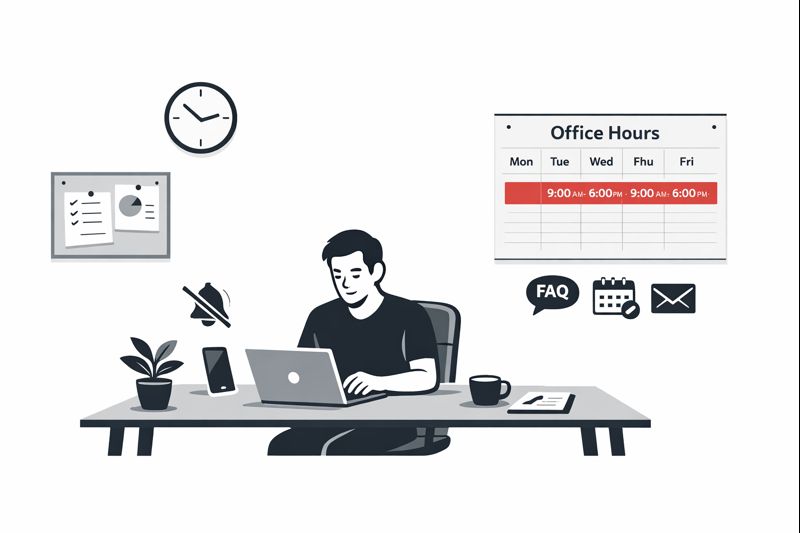
Here are boundary examples that work in the real world:
- Email: Replies within 24 business hours. Not “instantly.”
- Phone: Calls only booked via calendar. No random interruptions.
- WhatsApp: Used for urgent site issues only, not general updates.
- Support: FAQ + a clear “how to get help” page so common questions don’t become personal interruptions.
A boundary only works if it replaces the old behaviour with a better alternative. Otherwise people feel blocked.
So instead of just “no,” you offer structure: clear channels, clear expectations, clear next steps.
This Is Where Systems Win (And Hustle Loses)
Most founders try to solve the availability problem with personal discipline.
They say things like: “I just need to stop checking my phone.” “I need better work-life balance.”
But discipline is fragile. Systems are reliable.
That’s why the smartest move isn’t just “switch off.”
It’s building a business that still functions when you’re not looking at your inbox.
At WAi Forward, that’s the entire philosophy behind the way our tools work. We build automation that supports consistency without turning your business into a robotic machine.
Lead the WAi helps SMEs stay consistent with marketing and outreach without you having to manually push every action forward. And because it’s powered by RunWAi (our object-oriented AI engine), it understands workflows — not just prompts.
That means you can create structured processes that keep moving, even when you’re offline. The goal isn’t to “replace you.” The goal is to stop your business depending on your constant attention to function.
What to Do Next (Simple, Realistic, Immediate)
You don’t need a full business overhaul this week. You just need one boundary that makes you more effective immediately.
-
Pick one channel to restrict for 7 days.
Email is usually the best place to start. Example: no responses after 7pm. -
Add a clear message that sets expectations.
Example: “Replies within 24 business hours. If urgent, use [X].” -
Replace instant replies with a system.
Add an FAQ, a booking link, or a short autoresponder that routes people correctly.
Then stick with it long enough to feel the difference.
Because what you’ll usually find is this:
The business doesn’t collapse when you stop being constantly available.
It gets clearer.
More structured.
More professional.
And you get your brain back — which is the most valuable asset your business has.
Explore WAi Forward Solutions